Since I am currently not in a school library, I would like
to transform my future library into a learning commons that meets the literacy needs
of the school community, 21st century learning, and BC’s NewCurriculum.
The LC would incorporate the “NCTE [National Council of
Teachers of Education] for 21st Century Curriculum and Assessment”
whose framework can be found at
Also, there are many good documents, articles, workshops,
and websites that discuss about the importance of LC for collaboration, problem
solving, inquiry, critical thinking, innovation, and flexible learning.The following resources are very helpful
in the transformation of a traditional school library into a learning commons:
BCTLA’s website on “Learning Commons…” resources that can be
retrieved from
Ekdahl, Moira & Zubke, Sylvia.(2017) Learning Commons:A Pro-Active Model for Educational Change.British Columbia Teacher-Librarians’
Association.Retrieved from http://bctf.ca/bctla/pub/documents/2017/SL2LLC.pdf
Leading Learning: Standards of Practice for School Library
Learning Commons in Canada.(2014).Canadian Library
Association.Retrieved from
For my vision of the future project, I would like to start
building a prototype LC’s website that will allow students, teachers and
parents easy 24 hour access to literacy and other pertinent information.
Some examples of elementary websites for inspiration that I
was looking at for creating my own ongoing website are:
Gleneagles Cha’axay Wikibrary in the West Vancouver
Schools
In
anticipation of the closing of my parents’ house next week, I have been busy
the last few weeks helping my parents pack up their belongings, donate unneeded
items, selling furniture on Craig’s List, and cleaning out their crawl space
and garage.As I am
looking through old boxes, I have come across many books that I have fond
memories of reading or hearing as a child and teenager in school and at
home.These books were part of my
literacy journey and instilled in me the quest for life long learning, stirred
my imagination, had me think beyond the text, and developed my passion for
reading.As a child that did not
know a word of English in Kindergarten and just recently arrived in Canada, learning
to read has opened up many great opportunities for me.
Books in the garage
Thus,
one of the main takeaways from Phase 2 is the importance of literacy for
learning, growing, innovation, critical thinking, problem solving,
communication, and empowerment.It
is so important to “foster reading cultures in schools” as being literate helps in all aspects of school and life. But being literate in the 21st
century has vastly changed with the advancement of technology. Literacy in the 21st century doesn’t just involve
reading printed materials or writing but also involves digital literacy. Students and teachers are using multiiliteracies
and multimodal ways of learning in our connected global world for deeper understanding and ethical responsibility. The following articles discusses 21st century literacy: Alber, Rebecca. (2013). Deeper Learning: Defining Twenty-First Century Literacy. Edutopia. Retrieved from https://www.edutopia.org/blog/twenty-first-century-literacy-deeper-learning-rebecca-alber
Literacy is changing. So just
like the students, teachers also need to keep learning and incorporating 21st
century learning in our pedagogy as well as developing our ICT skills so that we can meet the needs of all students. Going back to university has been really beneficial and opened my eyes to more possibilities for learning for myself and the students. Workshops and conferences are great
ways to keep learning, be current, and share ideas. I also
think that Twitter, Blogs, Instagram, and TL Facebook groups are good ways to see what other
teachers are doing in the LC and recommending as resources for literacy,
learning and inquiry.
I think that it is pretty exciting for teachers that we can make learning more engaging and build more connections by integrating technology that helps all learning needs and inquiry. LC is a great spark for innovation and inquiry built on a foundation of literacy. For example, when I was in high school, we learned Shakespeare by reading the books, watching the plays, memorizing the lines, and using Cliff notes. But now, information on Shakespeare and his books can be readily found. There are graphic novels, YouTube Videos, Podcasts, Google Earth, online notes, images, online dictionaries, Smartboards for photos, and apps such as "Shakespeare's Globe 360 - Virtual Tour app" which is demonstrated at the following Youtube video and can found at https://www.youtube.com/watch?v=brstzAVO78I:
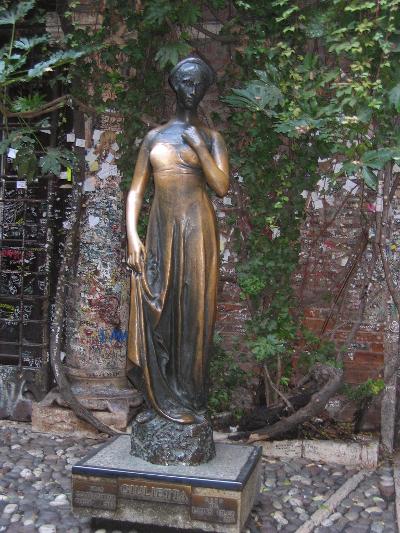
I could also try to build connections with my students by easily sharing personal photos on a Smart Board related to Shakespeare of our travels to London and Verona to ignite more inquiry reading and learning. Here are some photos that might increase their curiosity and perhaps they can share their own experience.:
The following photos in Verona that are related to Shakespeare's Romeo and Juliet play. The photos help increase dialogue and discussions. The first photo is us adding to the gum wall at Juliet's house. The next two photos are a statue of Juliet and Juliet's balcony.
I also think that it is important to have a global view of the world and help however we can. Students need to be mindful of how something as small as a smartphone, can be a large impetus for literacy development and a better life for someone in poverty or in other difficult situations. Smartphones and tablets allow access to library resources and educational apps which help develop literacy and provides empowerment. It might also be a catalyst for some students to see and increase the value of their own literacy when helping others.
Many ELL students whether they were born in Canada or aboard
come to school already at a disadvantage from their English-speaking
counterparts.Some ELL might be
fleeing from war torn areas or in poverty.They will have to learn a new language and adjust to new
customs.According to Jim Cummins, the conversational
proficiency known as BICS (Basic Interpersonal Communicative Skills) occurs
sooner than academic skills known as CALP (Cognitive Academic Language
Proficiency) which can take up to 5 to 7 years (Cummins, 1989). The use and understanding of
technology as one of the many tools and skills in a classroom/LC might be able
to help quicken the literacy growth, academic comprehension, and digital divide
between ELL and native speakers.
The research in the area of ELL and digital literacy in the
21st century is still a field that needs more research or more
experts to publish the great work that they are doing. I searched in the UBC
library publications, ERAC, and online with keywords such as "ELL, digital
literacies, technology, and 21st century," and there weren’t as many
resources as I hoped for especially for primary students.
A lot of the research and articles for
ELL on technology has been more on using apps to build vocabulary and
grammar which are important. But I was looking at a more subject integration and cross curricular approaches where vocabulary and grammar are not learned in isolation but is more
meaningful and knowledge filled.I was looking more for
innovative research and technology on how to empower ELL in the 21st
century so that they can have a voice.The hope is that all learners in our schools will be collaborators, independent
thinkers, inquiry seekers, and innovators.I wanted to find different strategies to engage and motivate
the students so that they know how to learn and be lifelong learners.
Perhaps the lack of time, access to technology, budget, professional
workshops, and teachers’ digital literacy skills have made it more difficult to
integrate and implement technology along side with learning strategies that
have been beneficial for ELL.Slowly but surely, the integration of technology in schools is being
used but it will take some time.
I have looked at many websites, videos, and blogs.I have read many academic articles and
chapters in books.I have chosen
those that are relatively recent, interesting, and that I thought would be
beneficial to the ELL in the LC or classroom.This curation will be a continual process and critical
evaluation to scaffold the differential needs of the student population that I
will be teaching.I am looking
forward to seeing what is being created in the future and what I can add to
that body of research once I am back into a school setting.I find it really exciting!
The following are the resources that I have curated.I have included an explanation and
thoughts for some.Others are
self-explanatory by their titles or were explained more in detail in my
previous blog.
Government and Curriculum Documents - provide a background knowledge and
framework for ELLs
-good resources that are “evaluated and approved” by
educators for the BC Curriculum and subject integration, there were 35
resources for the ELL search
Delacruz, Stacey et An, Sohyun. (2014).
Lights, Camera, iPads, Action! How a Fourth Grade Class Learned
21st Century Literacies Through Various Art Projects. New Waves - Educational Research and Development. Retrieved from
Early,
Margaret.Retrieved September 30,
2017 from http://lled.educ.ubc.ca/profiles/margaret-early/ -another great
expert on ELL, professor at University of British Columbia, many bodies of
research and projects, wrote about graphic organizers, multi-literacies,
Gunderson, Lee et al. (2013). ESL (ELL) Literacy Instruction: A
Guidebook to Theory andPractice. Routledge. Retrieved
from
Robertson,
Kristina. Preparing ELLs to be 21st-Century Learners. Colorin
Colorado. Retrieved on September 16, 2017 fromhttp://www.colorincolorado.org/article/preparing-ells-be-21st-century-learners -many great resources for
teachers and parents from different collaborators, it is American based with
links to the Common Core
-database of topics in ELL, some of the publications are dated
when using key words like “technology and digital literacies” and more articles
for older students but a good source to see what is happening in the field
Understanding ESL Learners:Distinguishing between Basic Interpersonal Communicative Skills (BICS) and Cognitive Academic Language Proficiency (CALP). Retrieved September 30, 2017 from
-good starting point to get general information on different
technologies such as digital storytelling, constructivism, Web 2.0 but
information should be used with caution and backed up with research (with all
wikis)
-many videos for curious minds
and to bring information and literacy to life
Conclusion
I think that it is important to integrate technology for ELL
(and all learners) with BC’s New Curriculum.The Internet is a vast resource of knowledge that can be
used to easily learn new ideas, share thoughts, see new images, and hear new
languages.When I was teaching
ELL, I was pretty skilled at drawing pictures and charts as a visual cue and
graphic organizers to build ideas and background knowledge but now at a click
of a button, I can bring the picture alive visually and through sounds on their
own personal devices or the smartboard.Learning can be explained in the ELL first language with such programs
such as Google translate if someone else in the class doesn’t speak their
language.The internet can let us
see together where they are from and what they value.We can meet their extended families over Skype if they have access to the internet.We can experiences places that we have never been.Providing the ELL the skills to access
school databases, video clips, and interactive e-books will allow learning to
happen anywhere and anytime. The authenticity that technology can bring into a
classroom will make learning more meaningful for all types of learners and
learning styles.
The world is changing at a quick pace technologically and we
need to find new innovative strategies that will bring ELL and for that matter,
all learners, into the 21st century so that they will be future
problem solvers and innovators in our global world.
The quest to find the best digital literacy resources and
strategies that will help ELL become 21st century learners continues. I am adding onto my search from last week with more government publications and academic literature research with data collection this week. The
hope is to find online research and ideas on how to effectively meet the social, digital, 21st century, critical, and
academic literacy needs of ELL who live in a multiliteracies world. These new developments in technology and multimodal literacies can further deepen understanding and be a motivational factor for learning.
One of the main research starting points for my
inquiry about my interest in supporting ELL with Digital Literacy in 21st Century
learning was to look at documents from the British Columbia Government
website on Education and Training as well as BC’s New Curriculum.
The new BC curriculum model shown below also allows the ELLs to learn multidisciplinary content by using technology that can integrate the big ides from the many subject areas and learning standards.
I also did a literature search with UBC's on-line library and found some interesting articles and books on ELL, digital literacy, and 21st century learning. It still seems to be an area of research that still needs more publications. There were a few dissertations from ProQuest that came up in my search so there should definitely be more publications and research in this area for the future. Below is a screenshot of my key words:
Here are some of the research articles and book that I found with my UBC library collections search:
Black, Rebecca W.
(2009). English –Language
Learners, Fan Communities, and 21st-Century Skills. Journal of Adolescent and Adult
Literacy. Vol. 52, No. 8.
This article discussed the importance of using technology that
the students were familiar with to build both print and information literacy as
well as multiliteracy.It didn’t
provide any on-line or digital resources that might be benefical for ELL. Another resource that came up as relevant to my UBC search was Lee Gunderson's book:
Gunderson, Lee et al.(2013).ESL (ELL) Literacy
Instruction:A Guidebook to Theory and
Practice.Routledge.
Dr. Lee Gunderson is a professor at UBC.Here is the link to his
information:
I actually have the 1st edition of his book,
which is quite comprehensive for teachers of ELL.Upon reading his latest 3rd edition book, there was a new Chapter 8 titled, “Technology, ESL, and Literacy Instruction.”It provided different online resources
that might be beneficial for ELL and literacy in that chapter. One of the sites that was recommended was the visual dictionary at https://infovisual.info/en. Gunderson also mentioned that
there was a companion website to the book of online resources as technology and
digital tools. The site was offered because technology is constantly changing, evolving, or being developed.Unfortunately, I wasn’t able to access
the website on my computer or telephone even after several attempts.
A third article that I read was:
Delacruz, Stacey et An, Sohyun. (2014). Lights, Camera, iPads, Action! How a Fourth Grade Class Learned 21st Century Literacies Through Various Art Projects. New Waves - Educational Research and Development
This article discussed using an interdisciplinary approach to teaching ELL that focused on the importance of art and combining it with academic subjects and 21st century literacies. The main focus of the article was the importance of integrating art and using the iPad to record their songs and plays.
I added the word technology and ESL to my UBC library search and read the following article:
Gustad, Alexandra Ritt. (2014). The impact of technology tools on literacy motivation on
elementary school English language learners: podcasting in a 4th grade EAL class. International
Schools Journal.
Gustad discussed using podcasting in our growing technological world to engage the students in literacy learning. The sample of students was very small but even though a couple of them found it difficult to listen to their voices, they still thought that it was a worthwhile educational tool.
I also looked for video clips on-line as I am a visual and auditory learner. There weren't too many sites on Youtube, but the site below I thought was quite helpful as it provide strategies to empower ELL's voice but using digital storytelling. Digital story telling can be used for them to tell a story about themselves, their family, and their country of origin. It can integrate all subject areas to build content and any inquiry need. It can be used individually and collaboratively. It can be shared, heard and seen repeatedly.
The Common Sense Education had links to other articles and blogs that were quite helpful. Here is a partial screenshot of some of their recommendation of "Top Tools for Dynamic Digital Storytelling":
Gustad, Alexandra Ritt. (2014). The Impact of Technology Tools on Literacy Motivation on
Elementary School English Language Learners: Podcasting in a 4th grade EAL class. International